


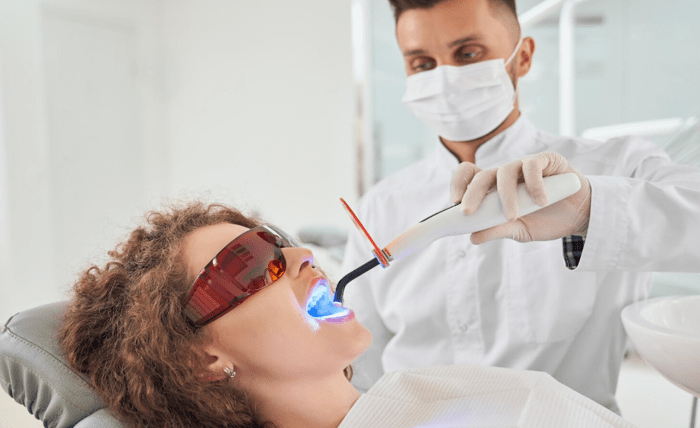
Whitening occupies an unusual position in dental tourism. It is one of the most requested treatments in Antalya, yet it is rarely the reason anyone books a flight — more often it is the first appointment in a longer plan, or an efficient addition to a trip already scheduled for something else. The appeal is straightforward enough: 60–90 minutes in the chair, no anaesthetic, and a result that home kits would need weeks to approach. With direct flights from the UK and across Europe landing in Antalya daily, it also works perfectly well as a standalone reason to travel for patients who want clinical-grade results without UK private pricing.
The Chemistry Behind the Result
Professional whitening works by applying a hydrogen peroxide or carbamide peroxide gel directly to the enamel, then driving the reaction faster with a high-intensity laser or LED light. The advantage over anything sold for home use comes down to concentration: consumer products must use weaker gels to be safe without supervision, which limits how deep the effect can go. In the chair, the gel is typically applied and light-activated across three or four rounds within one session. A desensitising agent at the end reduces the sensitivity most patients feel for the following day or two.
In-Clinic vs At-Home Whitening: Key Differences
| Factor | In-Clinic Laser Whitening | At-Home Whitening Kits |
| Treatment time | 60–90 minutes | 2–4 weeks |
| Gel concentration | Professional strength (25–40% HP) | Lower concentration (10–15% CP) |
| Result depth | Multiple shades in one session | Gradual lightening |
| Cost in Turkey | €150 – €250 | €30 – €80 for kit |
| Cost in UK private | £300 – £700 | £80 – £300 for custom trays |
| Longevity | 12–24 months | 6–12 months |
2026 Laser Whitening Price Comparison
| Country / Region | Average Cost | Notes |
| UK (private in-clinic) | £300 – £700 | Brands such as Zoom, Enlighten, or Pola; significant variation between clinics |
| Germany | €250 – €600 | Not covered by statutory dental insurance |
| Antalya, Turkey (Dental Harmony Turkey) | £300 | Single in-clinic session; comparable results to UK equivalent brands |
The gap against UK private pricing sits reliably around 50–60%. For anyone already flying to Turkey for other dental work, folding whitening into the same schedule costs almost nothing in additional time and very little in additional budget.
The Sequencing Rule Nobody Should Skip
This is the single most important thing to understand if whitening is part of a plan that also involves crowns or veneers: whitening comes first, always. Natural enamel bleaches. Ceramic does not. Fit restorations first and then whiten the teeth around them, and those restorations will sit visibly darker than everything else — a mismatch that can only be corrected by remaking them. For this reason Dental Harmony Turkey schedules whitening ahead of any ceramic work as standard practice. Patients considering E-max crowns in Antalya alongside whitening have the ceramic shade locked in only after the whitening session is complete, so the restoration is matched to the final brightness of the surrounding teeth rather than the starting one.
What the Day Looks Like, and the Days After
During the session: A protective barrier — either a rubber dam or a liquid resin — is placed over the gums first. The gel then goes on in several rounds, each activated for roughly 15 minutes, with total chair time of 60–90 minutes.
Immediately after: A chalky white appearance in the first few hours is common and expected. It resolves within 24–48 hours as the teeth rehydrate and the shade settles to its true level.
Sensitivity: Mild to moderate sensitivity for a day or two, particularly to cold, affects most patients and passes on its own. Using a desensitising toothpaste in the days either side of treatment noticeably reduces it.
Maintenance: The 48 hours after treatment matter most — keeping away from coffee, red wine, berries and heavily pigmented foods during that window helps the result hold. Longer term, occasional at-home top-up trays can stretch the effect out to 12–24 months.
Who Responds Well, and Who Does Not
- Yellow or brown surface staining from food, drink or tobacco — the most responsive cases of all
- Age-related darkening, which whitening reverses effectively since it is a gradual enamel change
- Partial results only: grey discolouration and tetracycline staining respond unpredictably
- Not appropriate: active decay, untreated gum disease, cracked teeth, or markedly sensitive enamel
- No effect at all: crowns, veneers and bonding, since neither ceramic nor composite bleaches
Is Laser Whitening Safe?
Carried out by a qualified dentist with properly calibrated equipment, whitening is well tolerated and considered safe. The risk is concentrated in two places — repeating the treatment too often, and applying it to teeth with untreated decay or existing sensitivity. Both are avoided by a proper clinical assessment beforehand, which is the argument against unsupervised home kits: non-customised trays leak gel onto the gums, and uneven application produces patchy results that are harder to correct than to prevent.
Final Thoughts
At £300 in Antalya against £300–£700 in the UK, whitening offers one of the cleanest cost comparisons anywhere in dental tourism — the same treatment, the same result, a straightforward difference in price. And for anyone already travelling for a larger procedure, it is an efficient use of both clinic time and the money already spent on the trip. Visit Dental Harmony Turkey for full details on Dental Treatment in Antalya and to check availability alongside other planned work.